Sales Operations: Governance of the Revenue Operating System
Sales Operations is what makes your sales process work consistently — not occasionally.
Start with something simple: how do opportunities move through your sales process today?
Are stage definitions clear?
Do managers trust the forecast?
Is your CRM clean enough to make decisions from?
Do reps follow the same standards when qualifying or advancing deals?
If the answer is “sometimes” or “it depends,” you don’t have a Sales Operations problem — you have a system problem.
At its core, Sales Operations builds a structured system that makes revenue execution predictable. It defines how opportunities move through stages, what data must be captured, how pipeline health is inspected, how forecasts are built, how managers coach performance — and only after that — how territories and capacity are designed.
For small and medium-sized businesses, structure matters even more. When teams are lean, inefficiency shows up immediately. One unclear stage definition or unreliable report can ripple through the entire quarter.
Sales Operations is the discipline that prevents that.
If you're new to the SalesOpsCoach framework, start with the full system overview:
👉 How to Increase Sales – The Sales Operations System
What Is Sales Operations?
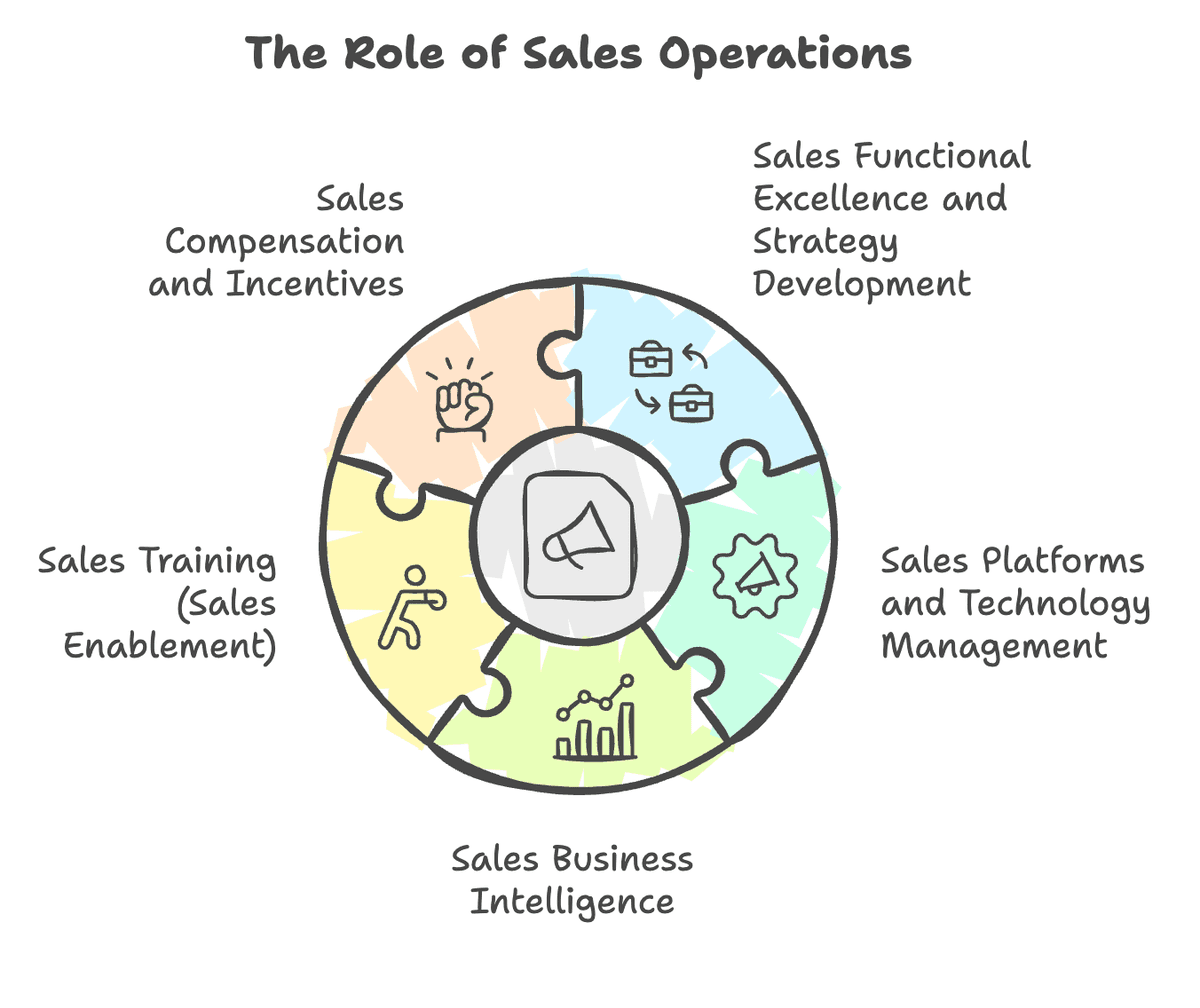
Sales Operations is the management system behind your sales team.
It connects:
- How you sell (process)
- What you measure (metrics)
- What you use (tools)
- How you improve (coaching and skills)
- And where you focus (strategy)
Many companies treat Sales Operations as a job title. In reality, it is a system. Even if you do not have a dedicated Sales Operations role, your team is already operating inside a system — it may just be informal or inconsistent.
The goal of Sales Operations is to make that system intentional, measurable, and scalable.
If you want a breakdown of responsibilities and ownership, read What Does Sales Operations Do?.
This page focuses on the bigger picture: how the entire system works together.
Sales Operations: The Governance Layer of the Sales Operations System
The Sales Operations System is the broader revenue framework that aligns strategy, process, performance, tools, enablement, skills, and AI into one integrated structure.
Sales Operations is the layer that governs and maintains that system.
While the master framework lives at the library level, this page focuses specifically on the discipline that keeps all components aligned, measurable, and enforceable.
At SalesOpsCoach, the Sales Operations System defines the full revenue operating architecture. Sales Operations ensures that architecture functions correctly in practice — through standards, inspection, governance, and accountability.
The broader Sales Operations System includes seven connected layers. Sales Operations plays a central role in orchestrating how they work together:
- Process & Pipeline
- Metrics & Accountability
- Tools & Automation
- Skills & Execution
- Strategy & Structure
While each layer has its own deep-dive hub within this library, Sales Operations connects them through governance, inspection rhythms, system design, and structural accountability.
The Sales Operations System integrates strategy, process, performance, tools, enablement, skills, and AI into one aligned revenue engine. When one layer weakens, friction shows up everywhere.
Let’s break it down in practical terms.
1. Process & Pipeline
Everything starts here.
If your sales stages are unclear, your forecast will be unreliable.
If exit criteria are vague, coaching will be inconsistent.
If qualification standards vary by rep, conversion rates will be unpredictable.
A strong sales process does not add complexity. It removes ambiguity.
Each stage should clearly answer:
- What must be true for this deal to move forward?
- What evidence confirms it?
- What is the next customer commitment?
Pipeline management then becomes inspection — not guesswork.
If you want to strengthen this area, start with the Sales Process hub and especially What Is Sales Pipeline Management?.
2. Metrics & Accountability
Once the process is clear, you measure it.
Many companies track too much and act on too little.
A practical Sales Operations approach defines:
- A small set of outcome metrics (revenue, win rate, cycle length)
- A few leading indicators (stage conversion, deal age, next-step compliance)
- Clear ownership for each metric
- A consistent review cadence
Metrics should drive decisions.
If no action follows the numbers, the system weakens.
Build this layer through the Sales Performance hub and resources like Sales Metrics and KPIs.
3. Tools & Automation
Tools should support your process — not define it.
Many teams buy software before agreeing on how they actually sell. That creates automation layered on top of confusion.
Start simple:
- Clean CRM structure
- Required fields that matter
- Clear stage logic
- Consistent activity tracking
- Usable reporting
Then automate repetitive tasks — reminders, hygiene checks, simple workflows — only after the basics work.
See the Sales Tools hub and What Is a CRM Platform? for practical guidance.
4. Skills & Execution
Even the best system fails if people cannot execute it consistently.
This is where Sales Operations and Sales Enablement intersect.
Operations identifies where breakdowns occur.
Enablement strengthens skills tied to those exact moments in the process.
For example:
- Weak discovery affects qualification stages.
- Poor value articulation affects proposal conversion.
- Lack of next-step clarity affects forecast accuracy.
Training works best when it reinforces real pipeline behavior.
Develop this layer through the Sales Skills hub and Sales Enablement.
SalesOpsCoach is also developing AI-driven simulation modules (coming soon) that allow teams to practice real-world sales scenarios aligned to their process and methodology — with structured feedback. The goal is practical application, not theory.
5. Strategy & Structure
Only after process, metrics, tools, and skills are aligned does strategic structure become powerful.
This includes:
- Defining target segments
- Clarifying ideal customer profiles
- Balancing territories
- Aligning capacity to growth goals
- Setting clear quarterly priorities
Without a functioning operating system underneath, strategy becomes aspiration.
With a functioning system, strategy becomes executable.
Explore foundational strategy topics in What Is a Sales Strategy?.
Why Most Sales Teams Struggle
Most teams do not struggle because they lack effort.
They struggle because their operating system is fragmented.
Common patterns include:
- Stage names exist, but stage standards do not.
- Forecasts are built on optimism instead of qualification evidence.
- CRM data is incomplete or outdated.
- Reviews focus on numbers but not behavior.
- Tools multiply while clarity declines.
When structure is unclear, managers rely on anecdotes.
When data is unreliable, trust erodes.
When accountability is inconsistent, performance varies widely.
Sales Operations fixes this by making execution visible and manageable.
From Framework to Implementation
Understanding the framework is step one.
Building it requires sequence.
Start with the basics:
- Clarify stage definitions.
- Define 4–6 core metrics.
- Clean CRM fields and enforce standards.
- Establish a weekly inspection rhythm.
These changes alone improve decision quality immediately.
From there, expand into structured planning, capacity alignment, and targeted capability development.
As your system matures, practice becomes the next lever. SalesOpsCoach’s AI-powered Skill Workshops allow teams to rehearse challenging scenarios, test decision-making, and reinforce methodology within a controlled environment.
Sales Operations is not about complexity.
It is about clarity.
Start Here
If you’re building or improving your Sales Operations System, follow this path:
- What Does Sales Operations Do?
- Marketing Strategy To Increase Sales
- What Is a Sales Territory?
- What Is a Sales Process?
- Sales Metrics and KPIs
- What Is a CRM Platform?
- What Is Sales Enablement?
Build Your Sales Operations System
Understanding the framework is important, but implementation is what creates results. SalesOpsCoach is developing structured learning paths to help teams apply each component of the Sales Operations System in a practical, step-by-step way.
These courses are designed to help leaders and managers turn concepts into operating habits, including process standards, metric reviews, tool governance, and execution coaching.
We are also building AI-powered Skill Workshops so teams can practice real-world sales scenarios in a controlled environment and reinforce consistent execution over time.
Frequently Asked Questions About Sales Operations
What is Sales Operations in simple terms?
Sales Operations is the system that makes your sales process measurable, consistent, and scalable.
Do small and medium-sized businesses need Sales Operations?
Yes. Even without a dedicated department, clear processes, reliable metrics, and clean tools help smaller teams grow without chaos.
What does a Sales Operations team typically manage?
Forecasting, pipeline standards, CRM governance, reporting, territory structure, compensation support, and performance reviews.
Is Sales Operations the same as Sales Enablement?
No. Sales Operations focuses on system structure and governance. Sales Enablement focuses on developing rep skills and reinforcing execution.
Sales Operations is not an add-on.
It is the system that makes sales strategy executable, performance measurable, and growth scalable.