What Is a Sales Process?
If you’re wondering what is a sales process, you’re not alone. Many businesses today lack the sales operations experience needed to define a sales process.
A sales process is a structured series of steps a salesperson follows to guide a prospective customer from the initial contact to the final purchase.
Part of the Sales Process hub: Sales Process.
It provides a repeatable framework for engaging prospects, identifying their needs, presenting solutions, and closing deals.
A Typical Sales Process
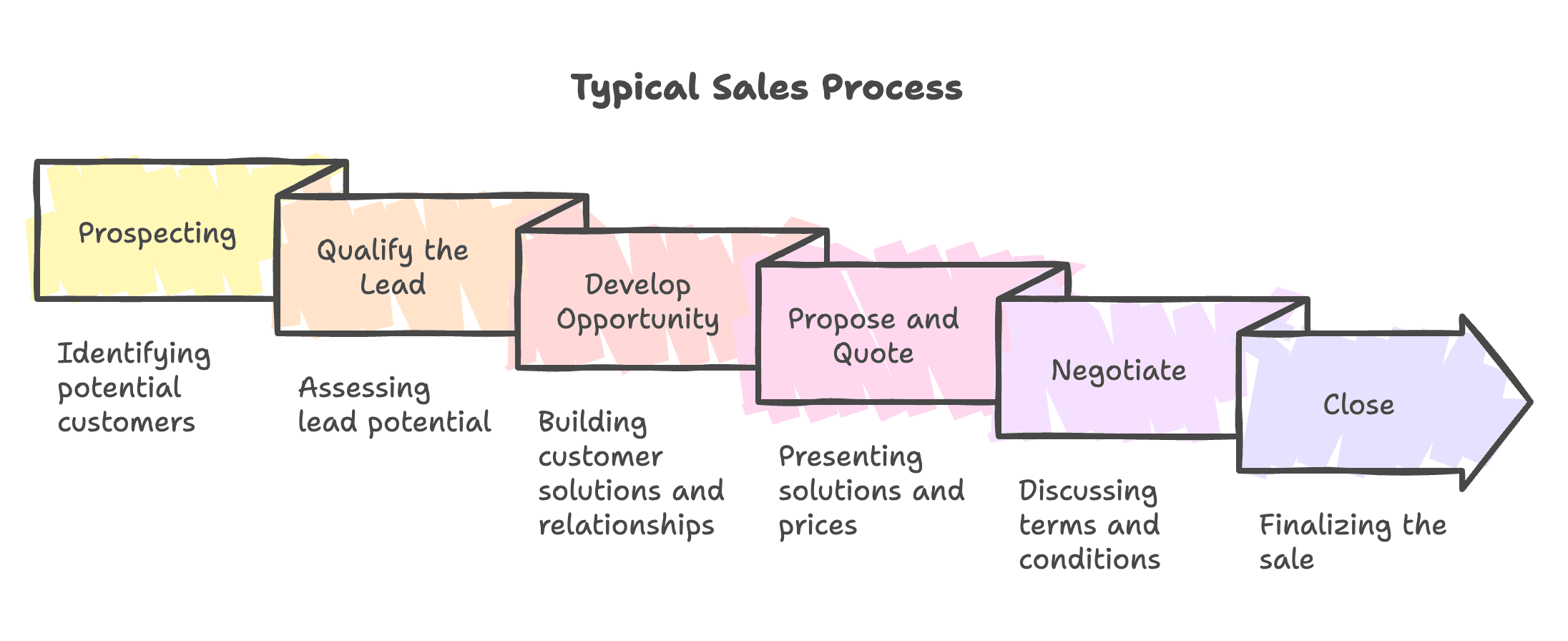
Here’s what a typical sales process looks like:
- Prospecting: Finding Potential Customers. This is where you identify people or businesses who might need your product or service.
- Qualifying Leads: Making Sure They’re a Good Fit. Not everyone will be ready to buy, so this step helps determine if they have the budget, authority, need, and timeline for your offering.
- Needs Assessment: Understanding Their Needs. Here’s where you ask questions, listen, and learn about their challenges and goals to see how you can help.
- Presenting a Solution: Sharing How You Can Help. Show them exactly how your product or service solves their problem or meets their needs.
- Handling Objections: Answering Questions. It’s natural for customers to have concerns—this step is about addressing those honestly and confidently.
- Closing: Sealing the Deal. When everything is in order, you finalize the agreement (e.g., contract or order).
- Follow-Up: Staying in Touch. After the sale, maintain the relationship through support, upselling, or check-ins.
Here, you can find a guide on defining the steps in a sales process that is unique to your needs.
Why Have a Sales Process?

It makes life easier for everyone. A good sales process helps sales teams stay organized, focus on the right actions to win business, and provide a better experience.
It also makes it easier to measure what’s working and where improvements are needed.
Think of it as your sales team’s secret recipe for success.
Benefits of Defining a Sales Process
- Predictability: Helps sales teams anticipate and navigate customer interactions with consistency.
- Training & Coaching: Provides a framework to onboard new sellers and continuously improve skills.
- Measurement & Optimization: Enables performance evaluation and highlights where to improve.
A well-designed sales process aligns with the company’s objectives and is tailored to the target audience’s preferences and behaviors.
The Sales Process and a CRM

The relationship between implementing a Customer Relationship Management (CRM) system and having a well-defined sales process is deeply intertwined.
A CRM is most effective when paired with a structured sales process, and conversely, a well-defined sales process can be significantly enhanced by the right CRM tools.
How a Sales Process Benefits CRM Implementation
- Clear Workflow Mapping: A well-defined sales process provides a blueprint for configuring the CRM so it aligns with stages, automations, and tracking.
- Customization for Relevance: A defined process helps you capture the right data at each stage (qualification criteria, touchpoints, pipeline metrics).
- Improved Adoption: Teams use the CRM more consistently when it reflects their day-to-day workflow instead of feeling like admin work.
- Data-Driven Insights: With a defined process, CRM reports can highlight bottlenecks, conversion rates, and trends for continuous improvement.
How a CRM Enhances a Sales Process
- Automation of Routine Tasks: Follow-up reminders, lead assignment, and email tracking free up time for selling.
- Improved Visibility: Real-time visibility into deal stage helps reps and managers prioritize correctly.
- Centralized Customer Information: Keeps all interactions and context in one place for better personalization.
- Enhanced Collaboration: Makes the process transparent across teams so everyone stays aligned.
- Scalability: Supports higher volumes of leads and customers without sacrificing consistency.
What is a Sales Process in the CRM context? The Sales Process and the CRM create a powerful combination that drives sales productivity, enhances customer experiences, and delivers measurable business outcomes.
The Sales Process and Sales Metrics

Sales Process + Metrics
The sales process and sales metrics go hand in hand.
Think of the sales process as the playbook that guides actions, while sales metrics are the scorecards that show how well you’re doing at each step.
Together, they create a powerful system to keep your team on track and continuously improving.
How Sales Metrics Help the Sales Process
- Tracking Progress: Metrics show how well each stage is working and where deals stall.
- Spotting Roadblocks: Metrics reveal bottlenecks (e.g., drop-off at proposals) so you can improve the flow.
- Predicting Success: Win rates and pipeline velocity help forecast what’s coming next.
- Improving Over Time: Trends highlight how to refine the process to be smoother and more effective.
How the Sales Process Supports Metrics
- Giving Metrics Meaning: Stage-based metrics show exactly where improvement is needed.
- Keeping Data Consistent: A structured process ensures data is captured the same way, making metrics reliable.
- Creating Accountability: Clear stages make responsibilities visible and measurable.
- Setting Goals: The process defines success and makes it easier to set realistic improvement targets.
Examples of Metrics for Each Stage
Below are some examples of sales metrics and KPIs at each stage of the sales process:
- Prospecting: Number of new leads or effectiveness of lead sources
- Qualifying: Percentage of leads that move forward
- Needs Assessment: Conversion rate to proposal or demo
- Proposals: Proposal acceptance rate
- Closing: Win rate and average deal size
- Post-Sale: Retention rates and upsell opportunities
Next read

Designing the steps in a sales process is the first step to improve your sales productivity.

What is Sales Pipeline Management? Sales pipeline management is the process of tracking and organiz…
Sales metrics and KPIs are measurable indicators that track the performance and effectiveness of sa…
Summary - What is a Sales Process?
What is a sales process?
It is the backbone of a successful sales organization.
It offers a clear roadmap to maximize efficiency, increase win rates, and provide a consistent experience.