How to Define the Steps in a Sales Process
Defining the steps in a Sales Process tailored to your business is essential for driving consistent success and improving productivity.
The structure of this process often depends on your selling strategy, whether it's Solution Selling, Account-Based Selling, Strategic Selling, or Social Selling.
Part of the Sales Process hub: Sales Process.
Each strategy has unique approaches that guide how you interact with prospects and customers. A well-defined sales process ensures that your team operates efficiently and focuses on high-value activities, from identifying leads to closing deals.
This page will help you understand different selling strategies, build your sales process step-by-step, and integrate best practices to achieve measurable results.
Selling Strategies and Descriptions
Understanding different selling strategies is key to tailoring your sales process and maximizing success in engaging prospects and closing deals.
By understanding when and how to apply these strategies, you can craft a more effective and flexible sales process that resonates with diverse buyer personas. This improves your ability to close deals and strengthens your overall sales pipeline by creating a consistent framework for success.
Solution Selling: This approach focuses on understanding the customer’s pain points and offering tailored solutions rather than pushing a specific product. It's ideal for businesses selling complex or customizable products/services.
Account-Based Selling: Targets key accounts rather than individual leads, emphasizing personalized approaches for specific companies or high-value prospects. This strategy requires collaboration across sales and marketing teams.
Strategic Selling: Centers around understanding the decision-making hierarchy within a client’s organization. It involves building relationships with multiple stakeholders to influence purchasing decisions.
Social Selling: This approach leverages social media platforms to build relationships, engage with prospects, and nurture leads. It’s a modern, low-pressure approach that works well in digital-first industries.
Exhaustive List of Potential Sales Process Steps
To build robust steps in a sales process, you must identify the actions that truly add value to your process and customers. Start by asking key questions: Is this step necessary for the product or solution I sell? Will it directly benefit my customer or contribute to their decision-making process? Each step should have a clear purpose, whether addressing a customer need, resolving a pain point, or moving the sale closer to completion.
Focusing on value-driven actions can streamline your process, improve efficiency, and enhance the overall customer experience.
Build product knowledge
Gain a deep understanding of your product or service, including features, benefits, and how it solves customer problems. This ensures confidence when discussing and demonstrating it to potential buyers.
Create a buyer persona
Develop detailed profiles of your ideal customers based on demographics, pain points, buying behavior, and goals. This helps tailor your messaging and approach to resonate with your audience.
Market research and analysis
Analyze industry trends, competitor offerings, and customer needs to identify opportunities and position your product effectively in the marketplace.
Identify ideal customer profiles
Define the characteristics of accounts most likely to benefit from your solution, focusing on factors like company size, industry, and purchasing capacity.
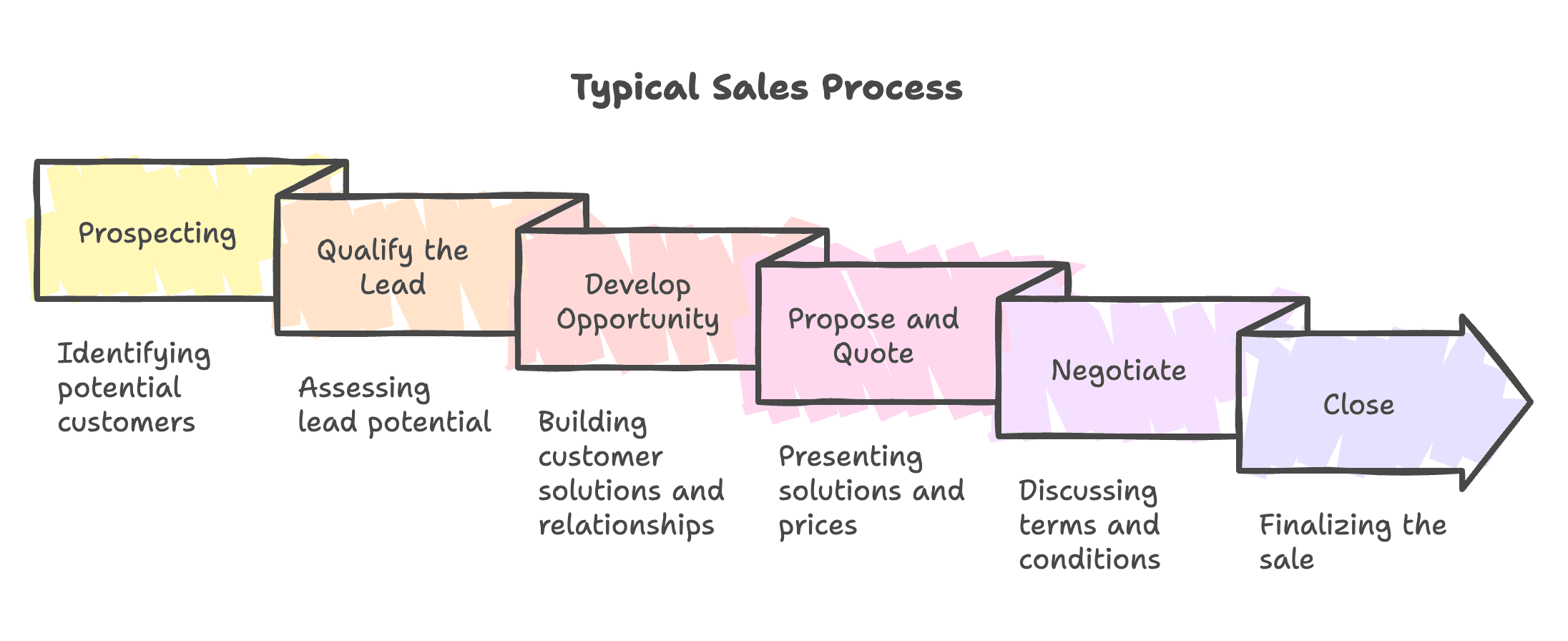
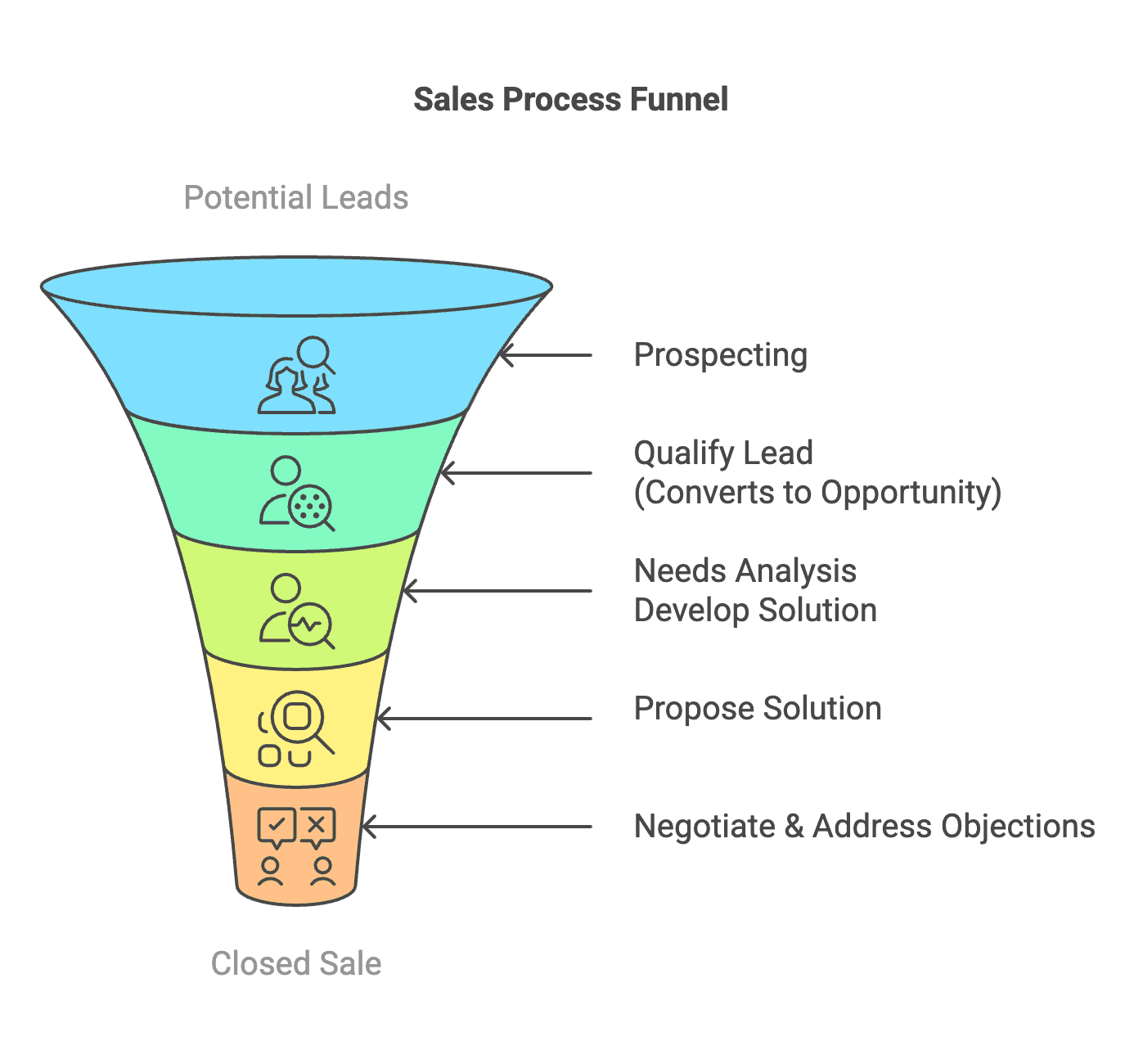
Prospecting
Search for and identify potential customers using various channels, such as social media, networking events, or cold outreach.
Lead qualification and discovery
Evaluate whether a prospect has the budget, authority, need, and timeline (BANT) to purchase. Conduct discovery calls to uncover pain points and objectives.
Make your sales pitch
Present a compelling value proposition tailored to customers' needs, explaining how your product or service solves their problems.
Present a demo or proof of concept
Showcase your product through a live demo or trial, allowing the customer to experience its benefits firsthand.
Address objections
Listen to and resolve any concerns or doubts the prospect may have, using evidence and tailored responses to build trust and confidence.
Proposal creation
Develop a detailed proposal outlining the solution, pricing, and terms, demonstrating how it meets the customer's needs.
Negotiation
Work with the customer to address terms, pricing, or conditions, finding a mutually beneficial agreement while maintaining profitability.
Closing the deal
Obtain verbal or written commitment from the customer to move forward with the purchase. This may involve finalizing terms and confirming timelines.
Contract signing
Formalize the agreement through a signed contract, ensuring all terms and conditions are documented and agreed upon.
Post-sale onboarding
Help the customer implement and start using the product or service effectively, providing training, resources, and support.
Nurture the relationship
Maintain regular communication with the customer, offering assistance, checking in on progress, and strengthening the partnership.
Upsell and cross-sell
Identify opportunities to offer additional products or services that complement the customer's purchase, adding value to their experience.
Gather customer feedback
Collect insights about the customer's experience to identify areas for improvement and ensure ongoing satisfaction.
Retention strategies
Implement loyalty programs, proactive support, or exclusive benefits to retain customers and encourage repeat business.
Examples of How to Define Value-Driven Steps in a Sales Process
Lead Qualification
- Question: Do I need to qualify leads before moving forward for the product or solution I sell?
- Answer: Yes, if your product is a high-value solution requiring a significant investment, lead qualification ensures you focus only on prospects with the budget, authority, need, and timeline (BANT).
- Customer Benefit: It saves the customer time by ensuring your conversations are relevant and tailored to their needs.
Presenting a Demo or Proof of Concept
- Question: Will presenting a demo or proof of concept benefit my customer?
- Answer: If your product has technical features that are best understood through hands-on demonstration, a demo can clarify its value and address potential doubts.
- Customer Benefit: This builds confidence in your solution's ability to solve the customer's problem and provides tangible evidence of its benefits.
Post-Sale Onboarding
- Question: Is post-sale onboarding necessary for my solution?
- Answer: if your solution is complex or involves technical integration, onboarding ensures the customer can use it effectively.
- Customer Benefit: Ensures smooth adoption and helps maximize the return on their investment.
Matching Sales Process Steps to Selling Strategies
Sales Process Steps and Strategies
| # | Sales Process Step | Solution Selling | Account-Based Selling | Strategic Selling | Social Selling |
|---|---|---|---|---|---|
| 1 | Build product knowledge | ✓ | ✓ | ✓ | ✓ |
| 2 | Create a buyer persona | ✓ | ✓ (Tailored to target accounts) | ✓ | ✓ (Leverages social insights) |
| 3 | Market research and analysis | ✓ | ✓ (Focus on account-specific data) | ✓ | ✓ (Using online platforms) |
| 4 | Identify ideal customer profiles | ✓ | ✓ (Key for ABM strategies) | ✓ | ✓ |
| 5 | Prospecting | ✓ | ✓ (Target specific accounts) | ✓ | ✓ (Leverage LinkedIn or similar tools) |
| 6 | Lead qualification and discovery | ✓ | ✓ (Assess account readiness) | ✓ | ✓ |
| 7 | Make your sales pitch | ✓ | ✓ | ✓ | ✓ |
| 8 | Present a demo or proof of concept | ✓ | ✓ | ✓ | ✓ |
| 9 | Address objections | ✓ | ✓ | ✓ | ✓ |
| 10 | Proposal creation | ✓ | ✓ | ✓ | ✓ |
| 11 | Negotiation | ✓ | ✓ | ✓ | ✓ |
| 12 | Closing the deal | ✓ | ✓ | ✓ | ✓ |
| 13 | Contract signing | ✓ | ✓ | ✓ | ✓ |
| 14 | Post-sale onboarding | ✓ | ✓ | ✓ | ✓ |
| 15 | Nurture the relationship | ✓ | ✓ (Ongoing account engagement) | ✓ | ✓ |
| 16 | Upsell and cross-sell | ✓ | ✓ | ✓ | ✓ |
| 17 | Gather customer feedback | ✓ | ✓ | ✓ | ✓ |
| 18 | Retention strategies | ✓ | ✓ | ✓ | ✓ |
Simplified Sales Process
While a long list of steps can help you consider all aspects of a sales process, simplicity is key—fewer steps keep your team focused and the process efficient.
Simple Sales Process and Strategies
| # | Sales Process Step | Solution Selling | Account-Based Selling | Strategic Selling | Social Selling |
|---|---|---|---|---|---|
| 2 | Prospecting | ✓ | ✓ (Tailored outreach) | ✓ | ✓ (Leverage social networks) |
| 3 | Lead qualification | ✓ | ✓ (Align account needs) | ✓ | ✓ |
| 4 | Sales pitch | ✓ | ✓ (Account-specific messaging) | ✓ | ✓ |
| 5 | Negotiate and Quote | ✓ | ✓ | ✓ | ✓ |
| 6 | Close the deal | ✓ | ✓ | ✓ | ✓ |
Streamlined process reduces unnecessary steps that can create confusion or delay, allowing sales teams to focus on activities that directly add value.
Simplification helps customers navigate their buying journey with clarity, making it easier for them to make informed decisions.
Additionally, a simpler process is easier to replicate, train, and scale across teams, ensuring consistency in execution.
By focusing only on the most impactful steps, you eliminate redundancies, shorten sales cycles, and align better with customer needs, ultimately driving better results for your business.
Please reach out to us if you have any questions.
Next read
Here you will find what is a sales process, and develop a framework to increase your sales producti…
What is a sales lead? It’s a potential customer who has expressed interest in your product or servi…

What is Sales Pipeline Management? Sales pipeline management is the process of tracking and organiz…