Sales Process
How do opportunities actually move through your sales process today?
If you paused right now and asked your team to describe the stages, the exit criteria, and what qualifies a deal to move forward — would you get consistent answers?
A sales process is not a diagram for your website. It is the structure that determines how consistently your team converts leads, forecasts revenue, and coaches performance.
This hub will help you design, clarify, and manage a practical sales process that works in real businesses — not just in theory.
If you're new to the SalesOpsCoach framework, start with the full system overview:
👉 How to Increase Sales – The Sales Operations System
The Practical Sales Process Framework
Instead of starting with definitions, let’s start with the pieces that actually make a sales process work.
1. A Clear Stage Structure
Most small and medium sized businesses do not need a complex 12-stage process. They need clarity.
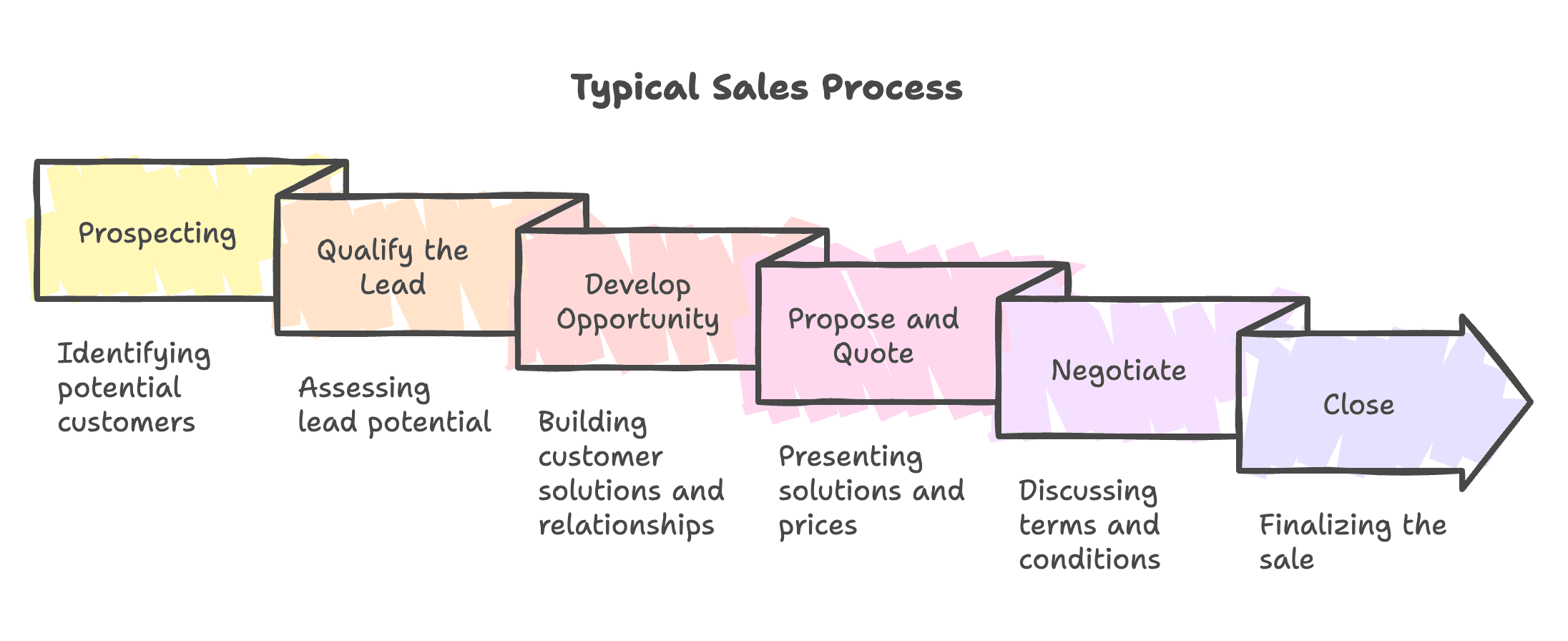
A simplified structure often works best:
- Prospecting
- Qualification
- Needs Assessment
- Proposal
- Close
- Post-Sale Follow-Up
The goal is not more steps. The goal is clear exit criteria so managers can coach and forecasts are based on evidence, not optimism.
If you want to understand how stages are typically structured, start with
👉 What Is a Sales Process?
2. Lead Qualification Discipline
A messy pipeline usually starts with weak qualification.
Not every contact is an opportunity. Clear lead-to-opportunity rules prevent wasted time and inflated forecasts.
A practical approach includes:
- Clear definition of a sales lead
- Agreed qualification standards (BANT or similar)
- Defined moment when a lead becomes a real opportunity
If conversion is inconsistent, read:
👉 What Is a Sales Lead?
3. Pipeline Management & Inspection
Once stages and qualification are defined, pipeline management becomes your control system.
Strong pipeline management includes:
- Defined stages
- Visible opportunity tracking
- Stage-based conversion metrics
- Forecast logic tied to stage reality
- Regular inspection rhythm
Pipeline management turns activity into visibility.
To strengthen this layer, see:
👉 What Is Sales Pipeline Management?
4. CRM, Metrics, and Process Alignment
A CRM should reflect your process — not replace it.
Your sales process should answer:
- What must be true before moving to the next stage?
- What data must be captured?
- Which metrics indicate stage health?
- How do we coach based on those metrics?
When process, CRM, and metrics are aligned, forecasting improves and coaching becomes specific instead of reactive.
To design the structure behind your workflow, read:
👉 Steps in a Sales Process
Start Here (Recommended Reading Path)
If you are building or improving your sales process, follow this order:
-
What Is a Sales Process?
Build the foundation and understand the structure. -
Steps in a Sales Process
Design your stages and align them with your selling strategy. -
What Is a Sales Lead?
Strengthen qualification and reduce pipeline noise. -
What Is Sales Pipeline Management?
Improve visibility, forecasting, and performance control.
Choose Your Goal
Not everyone starts at the same place. Choose the problem you want to solve:
- “We don’t have clearly defined stages.”
→ Start with Steps in a Sales Process - “Leads are not converting consistently.”
→ Read What Is a Sales Lead? - “Our pipeline is unpredictable.”
→ Focus on What Is Sales Pipeline Management? - “Our CRM doesn’t reflect how we actually sell.”
→ Review What Is a Sales Process?
How Sales Process Connects to the Bigger System
Your sales process is one part of a larger system.
- Sales Operations defines ownership, governance, and forecasting discipline.
→ Explore Sales Operations - Sales Performance focuses on KPIs, targets, and accountability.
→ Explore Sales Performance - Sales Tools support automation and visibility.
→ Explore Sales Tools
When your process, metrics, tools, and coaching are aligned, revenue execution becomes more predictable.
From Framework to Practice
Understanding a sales process is one thing. Running it consistently is another.
SalesOpsCoach is developing structured learning paths and AI-powered Skill Workshops that allow teams to:
- Practice qualification decisions
- Rehearse pipeline reviews
- Improve stage discipline
- Strengthen forecasting logic
The goal is not theory — it is better decisions in real selling situations.
A strong sales process does not slow your team down. It removes ambiguity so performance improves faster.
Next read
Here you will find what is a sales process, and develop a framework to increase your sales producti…

Designing the steps in a sales process is the first step to improve your sales productivity.

What is Sales Pipeline Management? Sales pipeline management is the process of tracking and organiz…